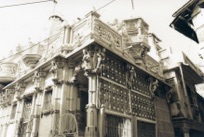

When Jains began moving from Mewad and Champaner to Kapadvanj, only part of the big group had moved to Kapadvanj.
Some had moved to Godhra about 40 miles east of Kapadvanj. Later on some will move to small towns of Mahudha (near
Kapadvanj), Lunavada and Vejalpur (near Godhra). They call themselves Nima Jains and preserved their group as one caste and
had marriage unions strictly among themselves. Some Jain families of Kapadvanj en route to and from Godhra found good farming
land at a very reasonable cost and bought it. Over the years about twelve families got involved and setup a secondary residence in
a village called Angadhi. (In later years, the Anand-Godhra railways passed nearby and Angadhi would have a train station.) They
maintained their main residence at Kapadvanj and would move between the two towns as required. Bhogi Dada married into a
family from Godhra and Girdhar Dada’s cousins in Godhra and Vejalpur maintained close relations with our family. In turn, my
father and uncles become friendly with those cousins’ sons and then too the grandsons on both sides also become friends. I know
two of them very closely, Arun (currently in Boston) and Bipin (currently in Mumbai). Bipin and I also ended up going to
engineering college together in Anand and remain good friends.
In Anghadi a small house was bought by the community and converted into a Jain
temple. Our family managed the temple property for many years. By 1950 most of the families
had closed their businesses in Anghadi after about 150 years of residence. Girdhar Dada
closed up the temple and transferred the money and idols to Modia’s temple in Kapadvanj.
While it lasted, the farms our family owned made the family reasonably rich. The house was big and had two bedrooms, a
large kitchen and a large dining area in the back. In the front of the house were a large enclosed porch and a big room serving as
an office cum living room. Three storage rooms were along the side of the house, and on top of the front of the house on the 2nd
floor of the house was a large room. When many people visited it functioned as a large bedroom. Enough beds and comforters
were kept on hand for about 20 to 25 people. Behind the house was a large yard with a barn for a horse, horse cart, a cow, three
bullocks and a bullock cart. All children were given fresh cow milk and the adults consume buffalo milk. There was also a small plot
for growing vegetables. The house also had 3 full time male servants, Fakirchand, Amirmia and Somaji, and a part time maid,
Manibhen. Manibhen would help in washing clothes, utensils and also took care of the cow. Fakirchand would help in the
warehouse and take care of the horse, Amirmia would take care of the bullock cart and the bullocks, and Somaji was dada’s
assistant and would visit the farms and help in distribution of seeds and money.
Girdhar Dada’s dealings with his farmers and sharecroppers were far better than most in his position. During the early
Mogul time, land revenue throughout India was the major source of government taxes. Land was given to landlords (zamindars)
and in turn they hired sharecroppers or sublet land in parcels to farmers who tilled the land. This tradition continued even
afterwards when citizens of means purchased large parcels of land. Taxes were high and most farmers and sharecroppers lived in
poor conditions. Landlords faired better, but due to the large tax burden they did not prosper as much as one might imagine. The
conditions worsened during the Maratha rule who exacted even higher taxes than the Moguls and were the worse still under
British rule. In the East (Utter Pradesh, Bihar and Bengal) the farmers almost lived in sub-standard conditions. In western India
conditions were a little better. Here too, many landlords exploited the farmers. There were few exceptions like Dada. The farmers
and sharecroppers, though illiterate, were not fools and recognized their landlords for what they were. As a result, Dada was very
popular and respected by his farmers. Every year the day after Diwali dada would leave Kapadwanj and go to Anghadi. All the
farmers would come to wish him a happy Diwali and say Sal Mubarak. Rukhi Ba, with help of the servants, would prepare sweets
(mostly Sukhadi and Magas or Mohanthal) for all of them. I had witnessed this a few times as a child when I would accompany
Dada.
During the independence movement, one item on the agenda was to improve the conditions of farmers. After 1947, the state
government of Mumbai took action and passes a law called “Khede Teni Jamin” (meaning the land belongs to the one who tills it).
The landlords were given some compensation for their land and within a few years all lands were transferred to the farmers and
sharecroppers. With this our business in Anghadi was closed. Dada was a follower of current affairs and politics and knew that
this was coming and had made sure his sons and grandsons were not much involved in his business.
Kapadvanj, while beginning to lose its old trading business, was made a Taluka by the British. The government
administration in the USA is four tiers, federal, state, county and lastly city or town. In India, the British established a five-tier
system which exists today, central, state, jilla (district), taluka and lastly city or village. The seat of a taluka would have a revenue
collection office, a government or a civil hospital, a court (for both civil and criminal cases), a police department, a public works
department and a high school. In India there were no city courts or city police. The taluka offices take care of the town in which it
is as well as the surrounding villages. For the Kapadvanj Taluka, the surrounding villages had a population of about 200,000 and
Kapadvanj itself about 30,000 (1950’s data). About eight to ten talukas would make up a jilla. In the 1950s Gujarat had twenty-five
such jillas.
Our house, and by extension all three adjoining houses, were ancestral properties. I do not know how long ago our family
houses in Kapadvanj were either bought or built. I only know that our family had the houses for a few generations prior to my
birth. Girdhar Dada had the two adjacent houses and Dada's kaki owned the third. Both Bhogi Dada and Girdhar Dada lived in
what we know as Manu Kaka’s house and what we know as my father’s house was used for the bedrooms only. Until the early
1940s all of Girdhar Dada’s sons and their families, as well as his two unmarried daughters, Vimlabhen and Sushilabhen, all shared
the same kitchen and common areas. At times, when my father and Dada would have to travel to Anghadi for business, their wives
would also go with them and it was Bhadra Kaki, Vimla Foi and Sushila Foi that looked after us. I recall these shared facilities and it
was these close quarters that enabled us cousins (Ramesh, Indira, Kokila and myself) to grow up very close and more as brothers
and sisters in these early years. With so many people sharing the same quarters, there was often a difference of opinion in
addition to it being very congested. Dada got the idea to split the growing families among the houses. Around this time his kaki
passed away and he inherited her house. It was a small old house in bad shape so Dada demolished it and built a brand new
house. With three sons that needed houses of their own, Dada decided to give one of each of his houses to three of his sons,
Chimin Kaka, Manu Kaka and my father. Since Chiman Kaka had a law practice and he needed office space, Dada rebuilt the third
house with four stories to accommodate office space on the second floor and the house was given to him. This third house was set
back from the street a few feet and you could in fact jump from our window onto his terrace. A stairway was built on the market
side of the house to allow clients to enter the office without going through the house. Of the two adjacent houses, Girdhar Dada
gave the main house to Manu Kaka. As Manu Kaka had settled in Mumbai, Girdhar Dada remained in that main house where he
had lived his whole life. My father took over the other house. Kika Kaka was given an equivalent amount of money as a house and
he worked with Dada in his business and he and his new wife lived with Girdhar Dada and Rukhi Ba.
In the 1920's Girdhar Dada renovated the two houses that he owned. Dada told me he had renovated the houses since they
needed repairs and he had a big family. The two houses, side by side they were mirror images of each other except that ours was
one foot smaller in width. The houses were connected in several places. In the front of both houses was an open porch (otla), and
four steps down to the street. Both porches were connected making it one big porch. On the left of porch was a small kitchen
(about 7 feet wide by 10 feet long) with a direct entrance from the porch as well as from the house. As you enter the house, on the
left was a small dining area and paniaru and the stairs heading to the second floor. A paniaru is a place where water is stored and
utensils are washed. Part of the paniaru was under the stairs. Under the stairs, metal pots contained water for washing dishes.
Later, when a water supply system was installed, two faucets were installed there. About three feet above the pots was a stone
shelf with big earthenware pots. These pots contained water for drinking and cooking. Earthenware pots are quite amazing. Even
in midsummer with temperatures up to 100 degrees, water would still remain cool. In fact, we would keep the milk on top of the pots
to keep it cool. On the right of the entrance was a big wooden bench (pat) that was used as sofa or an additional bed at night.
Behind this room was another room about 14 feet wide by 16 feet long. On the right side were seven or eight big metal drums, at
eighteen and twenty-four inches in diameter at four feet high, which were used to store dry foods. There was one each for rice,
wheat, moong beans, toover dal, bajari, etc. Above the drums on a wooden shelf there were all kinds of jars containing herbs,
spices, oil, ghee and varieties of mango pickle. Further up was another shelf of additional utensils. On the right were two
cupboards in the wall. This area served as a dining area when we had guests and would house the mahogany carved dining table
and chairs that my father would later buy. Behind this was the chindi, a room that was covered on three sides but was open to sky.
On the left was a bathroom that was only used for a bucket or shower bath. The open area had a bambo (copper boiler for hot
water) and was also used for washing clothes. This area of both hoses was also connected to each other.
The second floor had a small room above the kitchen and a big hall used as a sitting area during the day and a children’s or
guest bedroom at night. In the front of the room was a big balcony and here too the balconies of both houses were connected. In
front of the room above the kitchen and the otla was a big terrace used for drying clothes and also drying some foods during day.
In the summer it was also the place were everybody would want to sleep at night. On the top of dining room was my parent’s
bedroom. Lila had a steel cupboard for her saris and jewelry. Behind the bedroom on top of the bathroom was a small terrace
used as a urinal during the night for the children. The third floor was the same as the second floor except that the sidewalls of the
front room of both houses were removed making it one giant room spanning both houses. This room was used for parties on
occasion and was also a large guest bedroom used when dada's daughters or grandchildren would visit from Mumbai. Above the
third floor was a big attic, also common to both houses, which was used for storage. I mostly used the third floor bedroom as my
study room and bedroom. A few years after my father purchased the dining table he decided that it was not of much use as it only
sat six people. He preferred to have the space available downstairs and so the dining set was moved to the third floor and the big
dining table became our study table.
Dada had installed piped water and a sewerage system added to the houses as soon as the town had the system installed. In
the old times, the toilet was always kept outside the house. Traditionally, this was for one of two reasons; it was a septic system, or
in the case of a densely populated area, it was cleaned and the excreta was carried away in metal buckets by people of the sudra
caste known as Bhangis. They were untouchables and one of the most oppressed classes of people in India. Even with the coming
of the sewage system, the toilet remained outside the house for a long time. The piped water and underground sewerage system is
a 19th and 20th century invention. Kapadvanj was one of the few towns to have such a modern system in the mid 1920s. In Gujarat,
only Ahmedabad, Vadodra and a few other principal towns of native states (ruled by smaller Rajas) had it earlier. Even the big city
of Surat only had a sewer system after the Second World War. Most of the towns in Gujarat got their sewer system after 1950.
Kapadvanj was lucky to have had a forward thinking man named Vallabhram Trivedi as one of its residents. He had gone and lived
in Calcutta (then the capital of British India) for a few years and he had also visited Mumbai in 1915/1920 and seen the advantages
of the modern water supply and sanitary systems. When he retired and returned to Kapadvanj, he spoke about these things.
Some of the richer people, convinced that this was the right thing to do, collected funds for the scheme and applied to the state
government for installation. The British Governor of Mumbai state was impressed with the spirit of this small town and immediately
agreed to approve the application and help. More money was collected and by 1924/25 the town had the sewer system installed.
People had to spend their own money to install the system in their house and not everybody had the money to do so (including
some of our neighbours) and they depended on their neighbors or relatives. The two adjacent houses shared one toilet and
Chimin Kaka’s had its own. As the toilet was an external structure, we had a lock on the door and kept three keys for the three
brothers. We had two such neighbours that had no toilet of their own and who were allowed to use our toilet and also to fetch
water from our taps. Because of the demand for the toilet in the morning, I often found myself waiting on line to use our toilet
behind non-family members!
By the late 1930’s we also got electricity. However, it was short lived. During the war, copper was in short supply and the
British government decided that small towns could live without electricity. The small electrical generating station was closed. All
the wires from the streets were taken and used by the army. There were empty poles all over the town and people had all the
necessary wiring in their homes, but no power. By 1948 some people started a cooperative electric company (the old privately
owned company was already bankrupt) and with the help of the government got control of the old generating station. Luckily,
despite having sat idle for years, the generator was in good condition and with some minor repairs was back in use. A new
distribution system was installed using the old poles and power was restored. By this time, many more people wanted electricity so
another diesel generator was purchased. By 1951 anyone who could afford to install the system in their house could have power.
The Kapadvanj high school established in the 1880’s (after 1910 run by the town council) would have great benefits for the
region. People from as many as forty miles away would come to Kapadvanj for schooling. In my own class there were about five or
six kids who came from thirty miles away. (The town had three boarding and lodging houses for out-of-town students.) It was
only after 1950 that other smaller towns and villages opened their own schools. In 1940 some people organized the Kapadwanj
Kalvani Mandal (Kapadwanj Education Society), Manu Kaka was one of the founders of this group and later served as its
president. The Kalvani Mandal started a Montessori school, a kindergarten, and a primary school. By 1943 they founded another
high school and by 1957 a liberal arts and community college. The money we donated in honour of Lila and Nagin Kaka was
donated to the Kalvani Mandal High School to build classrooms for their computer program.
All of Dada’s grandchildren bought up in Kapadwanj would go through the schools of the Kalvani Mandal. His youngest
daughter, Shushila Foi, would also go to these schools. Dada and Sushila Foi had dreamt about her being the first Nima Jain girl in
Kapadwanj to graduate from high school. Unfortunately, she got sick, her eyes were in bad shape and she was forced to leave
school two years short of her graduation. This honor would go to her soon to be bhabhi (Manu Kaka’s wife) Sulochana Kaki.
Dada would also talk about things from his childhood, what he learned from his father, and what he had gone through with
his community when he dared to differ from them. He had some very interesting stories. In his younger days, Dada, had seen
tigers, cheetahs and other wild animals in the outskirts of Anghadi, but later in his life most of the wildlife had disappeared. He had
disagreements with his father just as I did. They had arguments and he went to Mumbai for a year or two and had a job there. (He
remembered clearly in those days that the trams (streetcars) in Mumbai were driven by horses.) When his mama called him to come
to Godhra he was all too happy to be away from his father. Nonetheless, he praised his father for his strict adherence to
cleanliness and order in his house and surroundings. My mom verified this fact about my great-grandfather. One story was about
a wedding that lasted a month. In his younger days, wedding ceremonies would normally last for eight to ten days. If the wedding
party was from out of town, it might even last a few extra days. This was the only occasion when relatives and friends living in
different towns could meet. One wedding of this type happened between a bridegroom from Kapadvanj and a bride from
Lunavada (a town about 80 miles or two days journey away by horse or bullock cart). Both sides were very rich and the wedding
lasted about twelve days and then the bride’s side insisted their guests should enjoy their hospitality for few more days. After
those few days it was bridegroom family’s turn to return the favour and the whole party lasted almost a month.
Dada often found himself at odds with traditional Jain thinking. He was fond of potatoes, onions and other Kandmul that
were readily available in Angadhi but not accepted by Jain tradition. He had engaged his eldest daughter, Dhirajbhen to Ramanlal
Panachand Teli when they were very young. After a few years he realized that Dhirajbhen was very aggressive, domineering and
short tempered, while Ramanlal was comparatively mild tempered and quiet. He thought it was not the right match and decided to
cancel the engagement. In those days he needed permission from the caste council (Nima Jain Punch) and the agreement of the
other party. After heated arguments this was agreed with two conditions, he had to engage his younger daughter Santa to
Ramanlal and he had to pay a large fine to the Punch.
Dada also had another encounter with the Punch. His eldest son, Chimanbhai, was engaged to Shubhadra (Bhadra)
Chimanlal Gandhi. She developed Kanthamal (lumps around her neck that are a type of cancer) and it was thought to be terminal
as little treatment was available at that time. Thus he decided to cancel the engagement and once again had to go before the
Punch and pay a hefty fine. Dada instead married Chiman Kaka to Lilavati Somabhai Doshi. Their first child, Ramesh, was just a
few months old when my parents were married. During the wedding, Lilavati went home to feed and put Ramesh to bed. In her rush
to return to the wedding, she slipped from the otla and fell down the four stone steps. She had internal injuries and died after a
few weeks. Ramesh’s maternal grandmother had actually just given birth to her youngest son, Chinu, a few months before and so
breast fed both her son and grandson. The rest of the child rearing fell to the new bride Lila. For this reason, Lila always held a
special affection for Ramesh and vice-versa. Meanwhile, to everyone’s surprise, Bhadra recovered from the Kanthamal and was
ready to take diksha. Her parents were still smarting from the broken engagement and still had hopes of her getting married and
so would not allow her to take diksha. At some point after Lila’s death, she contacted Chiman Kaka and they decided that they
would marry. Both sets of parents were vehemently opposed to this idea and would not support their children. After a few
months of this, Bhadra packed some of her clothes, left her parents home, moved into Dada’s house and told Dada and Ba that
she was going to stay no matter what. Realizing that there was nothing he could do, Dada let her stay and called a Gormaharaj and
got the basic wedding rituals done to legalize the union. Bhadra’s parents were furious and would not speak to her for almost nine
years. It was only after Shashikant was born that they accepted the marriage and resumed contact with her.
His big bold move came later on. Dada rarely observed daily Jain rituals. He would go to the Upashrya only during
Paryushan and Diwali and would only ever do puja during these occasions. The rest of the year he will just go for darshan. His
wife, Rukhi Ba was very religious and would observe all rituals everyday. She would also only ever use boiled water and did
chovihar (no drinking or eating after sunset) everyday. Two of their children, Chiman Kaka and Manu Kaka followed their father’s
example while the rest of the children took after their mother. A young main named Manilal Dahyabhai Shah from Kapadvanj took
diksha in 1910 and was named Punyavijay. He decided to spend his life doing research on Jainism and translating the old Jain
literature into Gujarati. As he pursued his work, he realized that he had to use light at night so that he could study. In the old time
all lights were either candlelight or oil lamp. The flame attracted moths, butterflies and other small insects that would die from the
heat. As a result, Jain monks were prohibited to use light and at night they would only meditate or recite prayers they knew, but
they would not read. With the invention of electric light, this objection should no longer be there. But old customs and practice
prevail and the use of electric light was prohibited. When Punyavijay decided to use electricity orthodox Jains were shocked and
strongly opposed this. When Punyavijay decided to visit Kapadwanj many local Jains were refusing to let him come and some even
threaten to beat him (Ahimsa being conveniently forgotten). Only a few welcomed him, and Dada was one of them. This strained
his relations with some of his brother-in-laws on both sides that were staunchly against Sadhus using light. As far as I know,
grandma’s brother (our Muta Mama) and dada were not on speaking terms for the rest of their lives. Today, many Jain temples
and Upashrya have lights. Although some sadhus use it and some do not. (Your mama and mami maharaj do not use light.)
Punyavijay did a lot of research and established a big Jain library and research center in Ahmedabad, recovered many old
manuscripts from different places in Gujarat and Rajasthan and was honoured by the Jain community and national government.
When I was growing up Kapadvanj’s population was about twenty percent Muslim. They were basically divided into two
groups, Bohras and Sunnis. Bohras were traders and businessman and also among the first to move to Mumbai. Some even
went to Calcutta and other Indian cities, while some even went overseas. Most of them were well to do and when they left
Kapadvanj they got into even bigger businesses and become very wealthy. Many of the Bohras are now either big businessman or
professionals in Mumbai. In Kapadvanj they had the finest houses filled with fine furniture and decorations. There was a group
that was very philanthropic and they established a library and a hospital in Kapadvanj. When some of them decided to leave town
for better business opportunities, they sold their property to people like my father who would by their furniture and decorations.
Over the years, our living room, dining room and one set of bedroom furniture came to us in this way. The Sunnis were farmers,
milkmen, craftsmen, truck drivers, mechanics or laborers. Most of them were poor or lower middle class. Very few went to school, I
had only two or three in my class, and during the British rule very few had joined army or police. Up until 1960 there was very little
Hindu-Muslim tension in the town. I understand that these days the situation has changed. During the Gujarat riots in 2002,
Kapadvanj was among the worst affected towns.